Small steps move you faster. What Shenzhen taught me about execution.
A Swiss CTO told me he looks forward to implementing AI in five years. In Shenzhen’s Robot Valley, start-ups ship in months. The difference is not the technology, and not only the state. Models and hardware you can buy. Execution you cannot. My side of a conversation with China expert Josef Mondl.


This post grew out of my conversation with Josef Mondl and Ladina Spiess in Episode 6 of Josef's podcast «China entschlüsselt» (China decoded), a series on how China’s system works beneath the headlines. The episode, «AI and the dual bureaucracy: the strategic multiplier», looks at how China’s system of government turns AI into a strategic multiplier, and asks why the country gets from idea to implementation so much faster than the West. Josef covers the system. I cover what I saw on the ground.
Podcast AI & the Dual Bureaucracy
A few weeks after I came back from Shenzhen, I sat with the CTO of a Swiss company. His executive board had asked us where AI could make the firm more efficient. We had done the work, the use cases were on the table, and we needed his support. He was friendly about it. He liked the ideas. And then he said he was looking forward to implementing them in five years.
Five years. First the AI guidelines, he explained. Then governance. Then the data protection reviews, the cost-benefit analyses, the digitisation of the processes, and finally the dismantling of the data silos. Then, AI.
I did not argue. He was describing how things are done. And he was describing, in one sentence, why nine out of ten Swiss companies use AI tools while fewer than one in ten has changed its business model with them, and why, in Swiss industry, only thirteen per cent see a measurable financial return. AI is everywhere. Impact is rare.
The valley where nobody waits
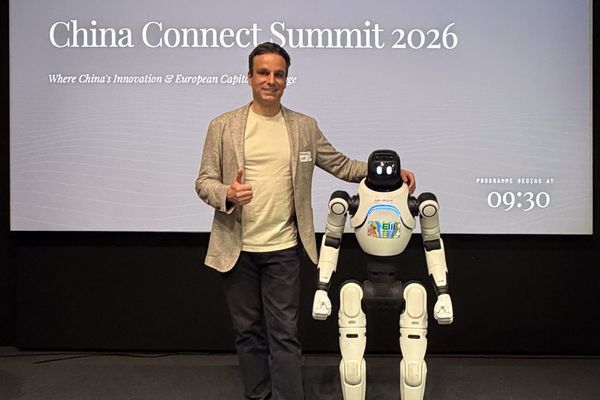
Earlier this year I was in Nanshan, a district of Shenzhen with a ten kilometre strip the locals call Robot Valley. Shenzhen counts over seventy thousand robotics companies, and ninety per cent of a robot’s parts come from within an hour’s drive. I visited several start-ups and scale-ups there, and the pattern was the same in each: a few dozen engineers, a prototype in a few months, then straight into a small production run that takes weeks, not quarters. The product is not perfect. It is good enough to charge money for. Then they improve it, with paying customers, in the field.
One founder told me how he sees the competition from the United States. «Designed in California, made in China still works for now,» he said. «But anyone who wants to compete on price and speed will end up producing here.» He was not boasting. He was stating the weather.
The Chinese have a four character phrase for this way of working. 小步快跑, xiǎo bù kuài pǎo. Small steps, run fast. You take a small step forward. If it does not fit, you take one back, or sideways. But you keep moving. It is a slogan in the big tech companies, and after a week in Shenzhen you understand why they chose it: it describes what they already do.
The plan is real, and so is the follow-through
The evening after the valley, I had dinner with a government official who works for a fund backing chips, AI and robotics, about thirteen billion dollars by his account. The fund is one brick in a longer wall. In 2015, under «Made in China 2025», Beijing named ten industries it wanted, among them electric cars, batteries and solar. Ten years on, China builds around seventy per cent of the world’s electric cars, one Chinese battery maker, CATL, supplies nearly forty per cent of the world’s EV batteries, and China holds over eighty per cent of every manufacturing stage of a solar panel.
The new five year plan for 2026 to 2030 puts AI, biotech and robotics in the same place, and everything lines up behind it: laws for driverless cars, 12 billion yuan for landing pads and a radio network for drones in Shenzhen alone, AI on the curriculum from primary school to university, government support for the training data behind humanoid robots. And the companies line up too. In China a firm does not succeed against the plan; it succeeds inside it. The founders in the valley know which industries are on the list, and they build there. Josef Mondl calls this China’s dual bureaucracy: one level sets the direction, the other executes, and cities compete to execute fastest. Patrick McGee tells the story in «Apple in China»: when Tesla was cleared to build its Shanghai plant in 2018, Musk, never short of ambition, planned two years. The mayor offered one, with land and tax terms to match. The factory went up in a year.
It is tempting to stop here and say: that is why they are fast, and that is why we cannot be. I draw a different lesson. Strip away what is specific to China and what remains is a method: set a direction, make a plan, implement it, accept the hard trade-offs that follow, and then hold the line. Switzerland does not need Beijing’s instruments to do that. A country can do it, a canton can do it, and so can a company. The valley is fast because founders and their teams execute. They execute because the direction is clear and all efforts are aligned. Both halves matter, and neither of them requires China.
What you can buy, and what you cannot
The usual objection arrives at this point. We are not China. We have no Robot Valley, no state fund, no market of 1.4 billion people. All true, and all beside the point.
Think of AI as two games. One is making it: chips, data centres, models, the hardware for robots. Europe is largely out of that game, apart from a few proud suppliers like ASML, Zeiss and Trumpf. The result is that any Swiss company can now buy models and hardware, cheaply, today, increasingly from China. Alice Han points out that China invests twenty-three times less private capital in AI than the United States, 12 against 285 billion dollars in 2025, and that its open models are still only months behind the frontier. She also notes that China has become the dominant source of AI tokens worldwide. The numbers bear her out: on OpenRouter, the marketplace developers use to route AI requests, Chinese open-weight models went from a rounding error to over sixty per cent of all tokens in eighteen months. Jochen Sengpiehl, formerly VW’s marketing chief in China, put it in one line: Europe discusses regulation, China discusses scale.
The other game is using it: AI in the office, in the factory, in the hospital, in the town hall. That game is open. Nobody has won it. And it is played one company at a time.
Here is the uncomfortable part. Models you can buy. Hardware you can buy. Execution you cannot buy. The CTO’s five year plan was not a technology problem. It was an execution problem dressed as prudence.
AI multiplies what is already digital
There is one more thing Shenzhen has that we do not, and it is not culture. It is groundwork. Chinese companies digitised their processes years ago, because serving a market that size without digital processes is impossible. When AI arrived, it landed on fertile ground and worked immediately. AI is a multiplier. It multiplies what is already digital. Where little is digital, there is little to multiply.
Not everything works yet. China built nearly thirteen thousand humanoid robots in 2025, nine in ten worldwide, but about seventy per cent of the demand came from research labs, shows and training centres, and the founder of UBTech, China’s leading humanoid maker, says they are still only half as efficient as humans on a line. The valley knows this. It ships anyway, because the training data comes from the field, not from the lab.
In Switzerland we still wait for a business case that demonstrates a revenue increase or a cost reduction before we digitise the back office and break down data silos. The business case for groundwork never arrives, because groundwork does not pay by itself. By the time we find it, the competitor who treated AI as an accelerator has pulled ahead, and that gap does not close.
Back to the CTO
I thought about him a lot after Shenzhen. A Chinese company with the same list would not do it in sequence. It would start all six things in parallel and ship the first simple use case next week, imperfect, and learn from it. The mistake it makes is called learning. The mistake we fear is called failure. Same event, different name.
So here is what I took home. We will not build the most capable models. We will not build the hardware. We can learn to execute, and the way to learn it is not a five year plan. It is a small step on Monday. Then another.
小步快跑. Small steps move you faster. Why China runs this way is the question we take on in the episode above.