Three signals from the China Connect Summit in Zurich
Which robots pay off now, how Chinese AI companies run without managers, and why Chinese models at a twentieth of the price are heading for Europe.

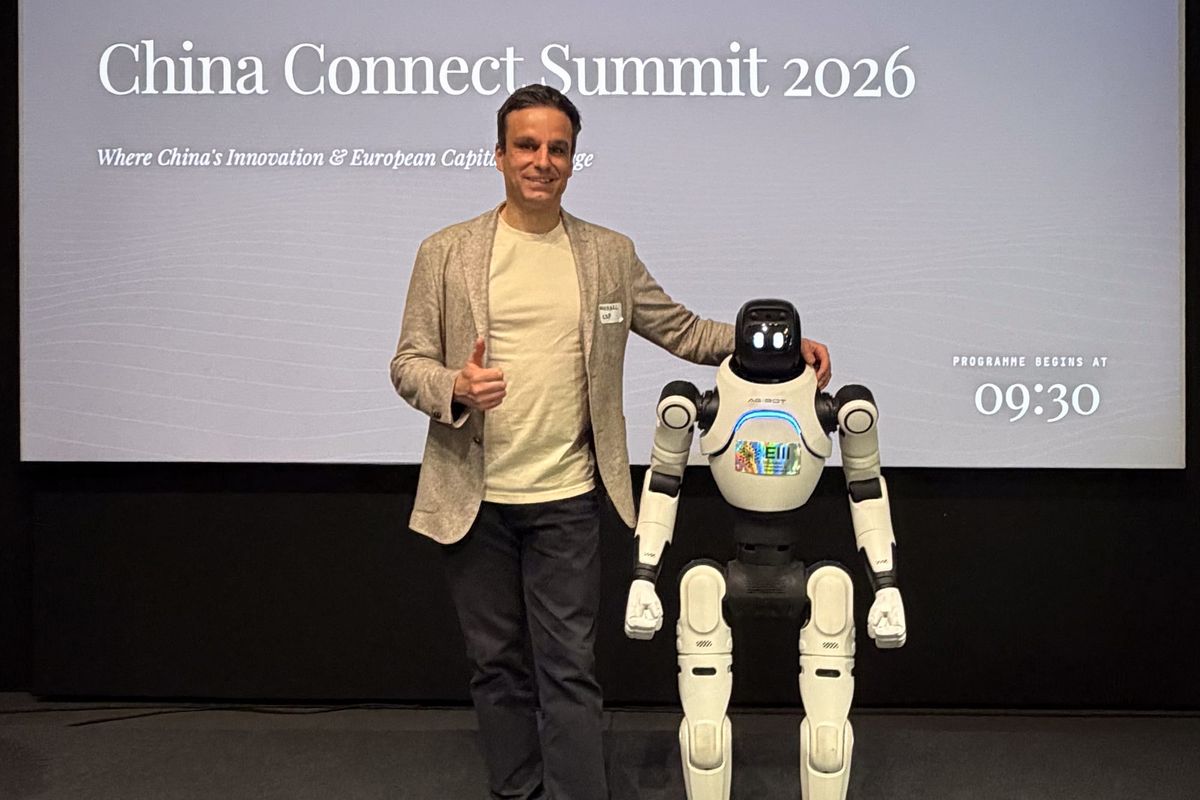
The China Connect Summit in Zurich on 2 October, organised by Danchun Chen of Varen Partners, put most of China's AI stack on one stage in one day. Kathy Xu of Capital Today, first investor in JD.com and Moonshot, on where the money goes. Alice Han of Greenmantle on the macro. HKEX on how Chinese tech gets listed. Minimax and Zhipu on the models. Genrobot, Sudo AI, Spirit AI and Wuji Hand on the robots, with humanoids and dexterous hands running live over lunch.
The event was organised for European investors, but here is what stood out for European executives looking at deploying Chinese AI technology.
Robots that pay for themselves are shipping. Humanoids need a few more years.
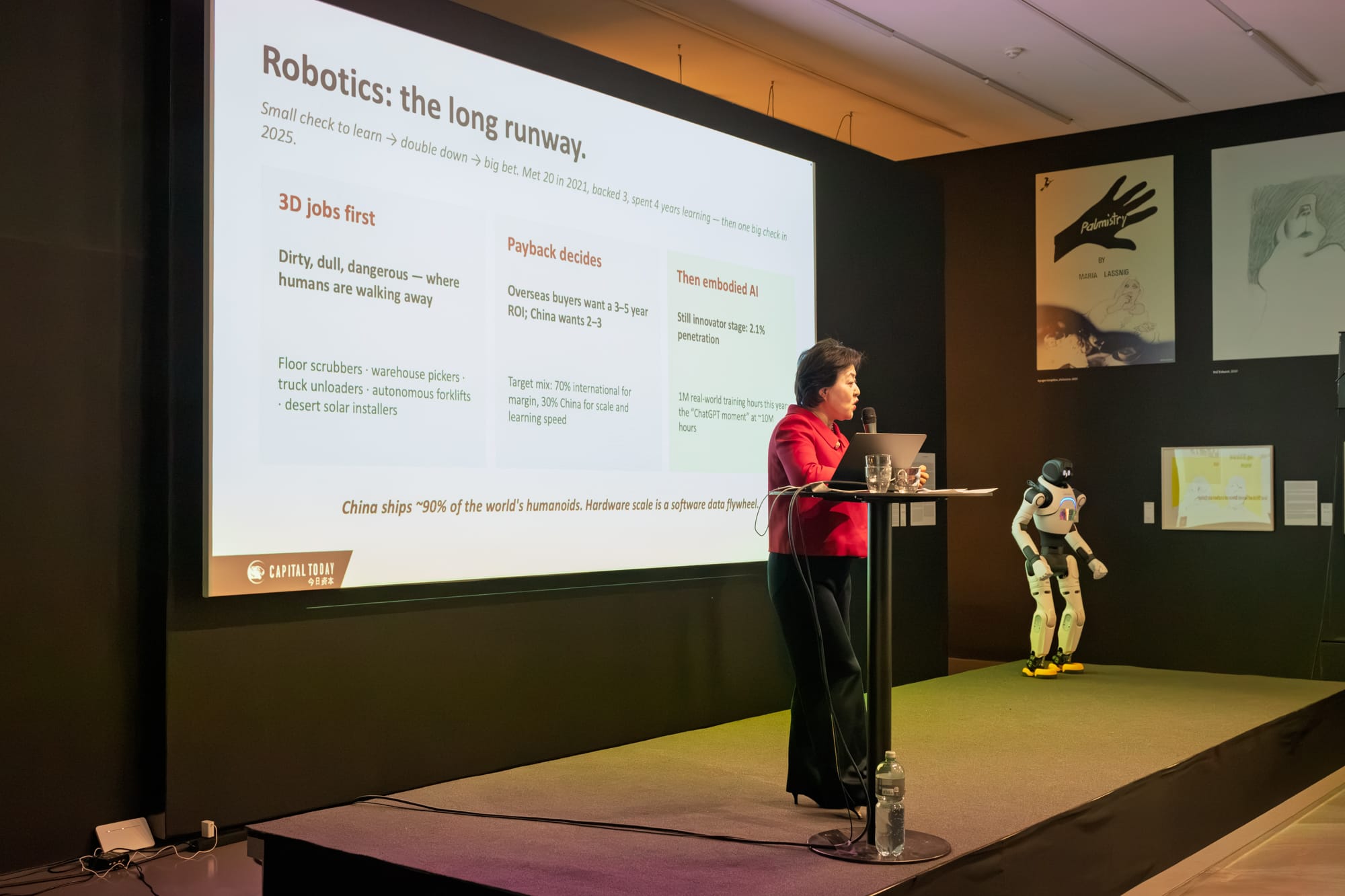
Kathy Xu's rule: if the worker costs $100,000 a year, the buyer pays $300,000 for the robot. Orders at her robotics companies grow 100 to 200% a year. A US car maker she quoted has a mandate to cut 40% of its workforce in five years. A forklift driver there costs $170,000, and the real problem is that they do not consistently turn up.
Humanoids sit at 2% adoption, by Xu's count. Robot brains learn from hours of recorded human demonstrations, and at half a million hours the industry saw for the first time that more hours reliably produce a better robot. It will have collected a million by the end of this year, and Xu expects the ChatGPT moment at ten million, one to two years out. I estimate this to be a rather optimistic timeframe but then again China never seizes to surprise. The first paid job will be warehouse sorting, within 18 months. China shipped 97% of the world's humanoids in the first half of 2026.
Her warning: the bodies will be commoditised by Huawei, Xiaomi and the car makers. The only defensible position is training the brain.
What to do: buy single-task robots now for every dangerous, dirty or dull job. Forklifts, trailer unloading, cleaning: they work today and the Chinese suppliers are shipping. Pilot humanoids to learn. When you visit a humanoid maker, ask about training hours, not the backflip.
The new Chinese company has no middle management
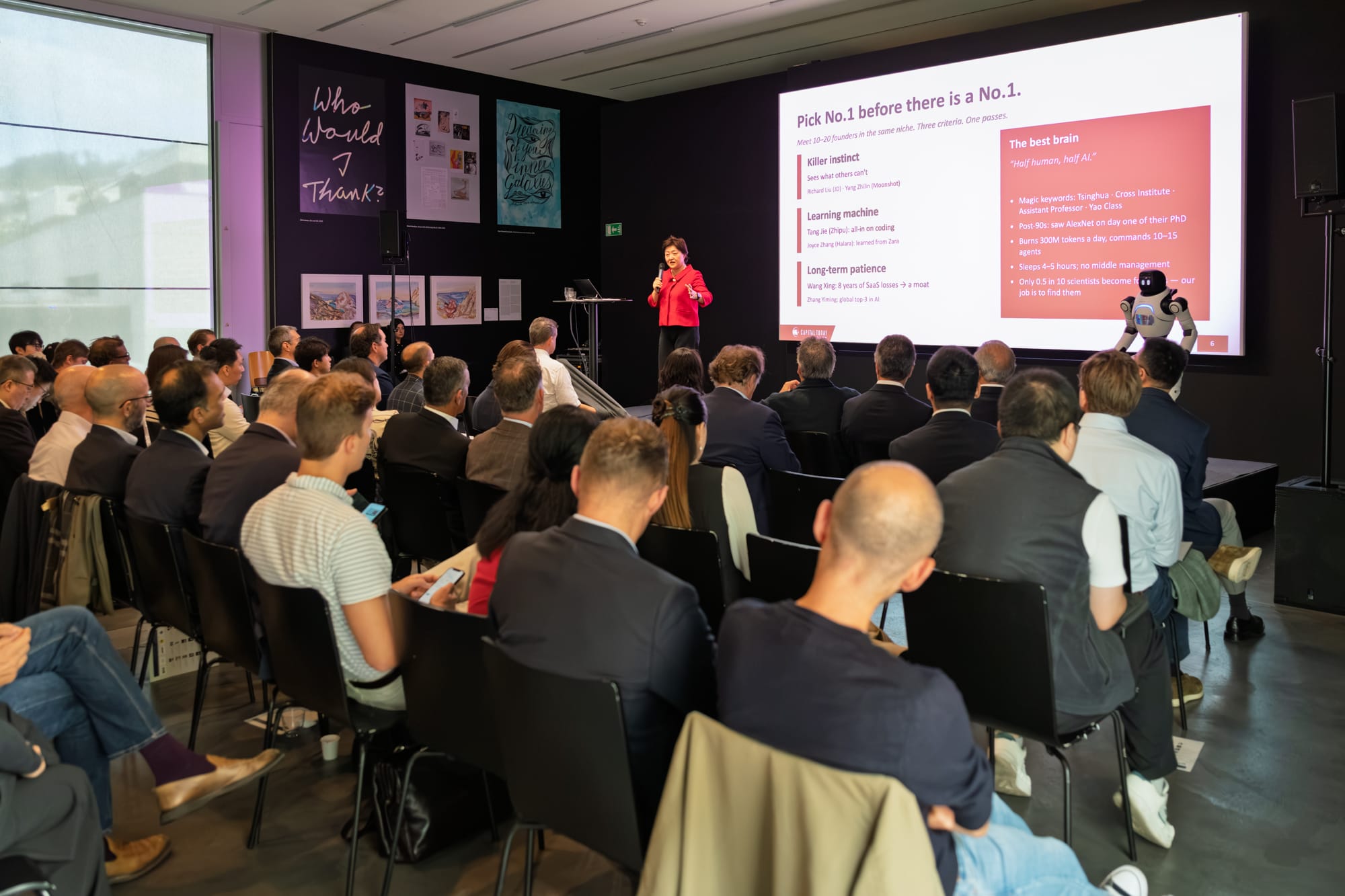
Kathy Xu described a new type of founder she calls half human, half AI. He burns 300 million tokens a day and sleeps four or five hours. Why so little? "I am the bottleneck. The agents are pushing me." His company: a founder, ten to twenty people, fifteen agents underneath. No managers, no humans in the loop.
The results: Fish Audio, voice models, from $20 million annualised revenue in September to a $50 million target in December. Halara, a fashion brand run on AI, $1.6 billion in revenue in five years with 600 people. Galaxy, twenty people, six months, a working robot brain. Minimax, frontier models in every modality with a thousandth of the US budget, because its GPUs run at 90% utilisation against 30 to 40% in American labs.
And the counterexample. A 100-year-old pharma company, 70,000 staff, 93% daily LLM use. HR built 50 agents and freed up 20 people. The 5,000 scientists went from 3 new molecules a year to 15, heading for 30. Automating the back office disappoints. Arming the people who make the money still pays, and that is where the innovation came from.
What to do: find the ten people whose judgement earns your margin and give them the tools first. Then ask which layers exist only because humans could not keep up.
Chinese AI is six months behind, twenty times cheaper, and on its way here
Alice Han's data puts Chinese models about six months behind the US frontier. The price gap is wider: on her cost chart, Zhipu's GLM 5.3 Flash costs $0.25 per task, Claude Opus 5.5 $5.98.
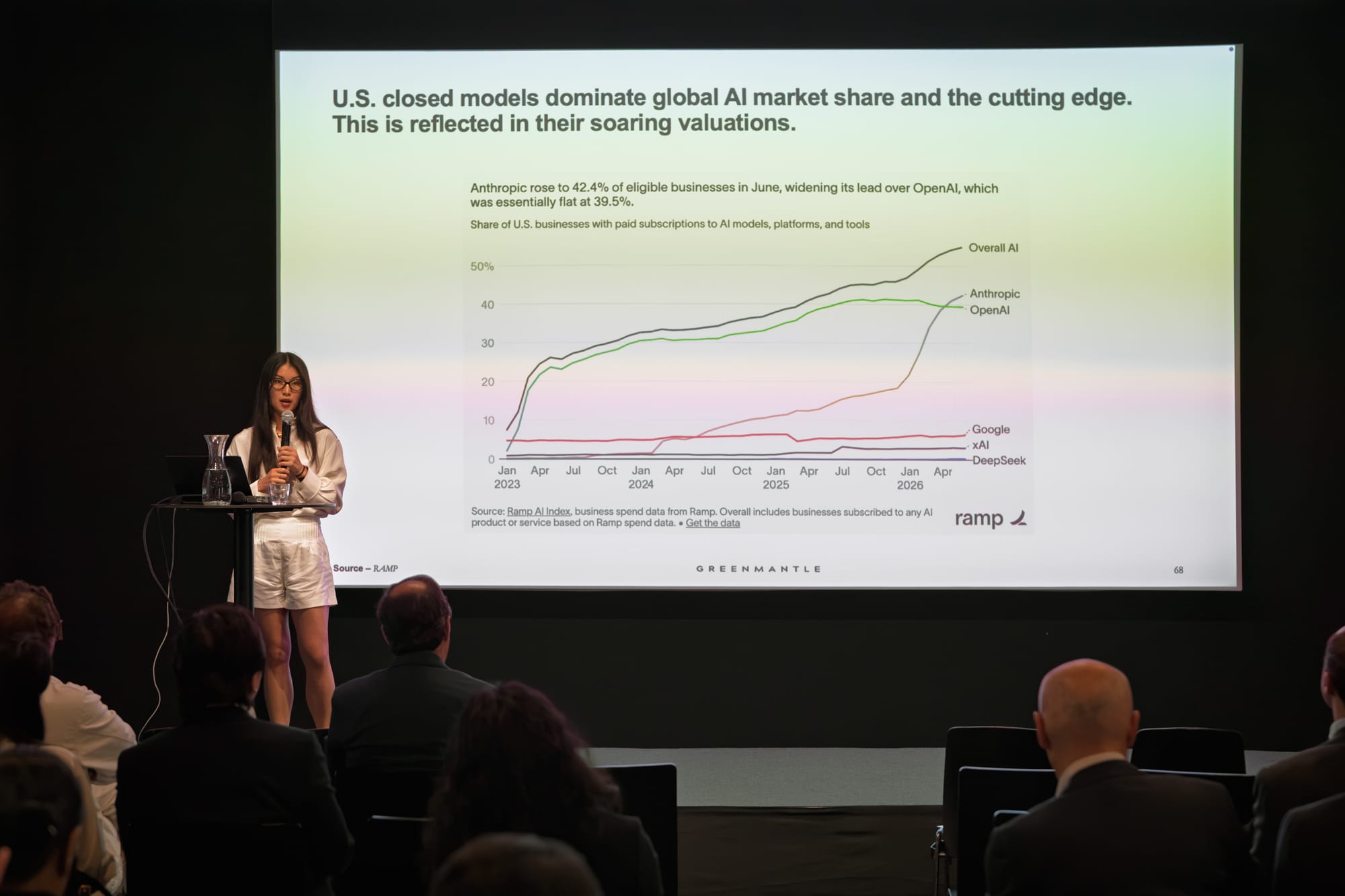
On OpenRouter, a marketplace where developers pick which model answers each request, nearly half of US companies' traffic now goes to Chinese open models, up from under 5% a year ago. Nobody cancelled their Claude subscription; on Ramp's spending data, 42% of US businesses still pay Anthropic and 40% pay OpenAI. The Chinese models run underneath, task by task, where nobody sees a logo. I doubt that split holds. Once agents do most of the work, the bill is what gets noticed. Stripe, according to Kathy Xu, expects 80% of its traffic on Chinese models by next year..
The sovereignty argument has changed sides too. Kathy Xu quoted the CEOs of Microsoft and Palantir: an API means paying twice, once in dollars, once in the knowledge the model learns from you. Open weights on your own servers avoid that. In Switzerland, that argument counts double.
And the macro: net exports now deliver 30% of China's growth. Beijing has named AI, biotech and robotics as the sectors it backs. China has to sell this abroad. Anyone who walks a trade fair knows how that looks: a quarter of the price, a step ahead, weak on local service.
What to do: use Chinese open models as a cost lever, on your own hardware where the data is sensitive. Expect the same Chinese firms to show up as suppliers and as competitors. The robot maker that could automate your warehouse will also sell to your customers; the model lab behind your cheapest API may also power your rival's product. Decide for each one whether you want to buy from them or beat them, before they decide for you.
Summary
Put the three together and the shape is clear. The first wave of AI lived on screens, and that wave is now cheap and open. The next wave moves into physical work: warehouses, factories, delivery, care. China ships 97% of the humanoids, owns the supply chain, collects the training hours and has told its companies to go abroad.
The summit put a humanoid on stage so investors could see one. If you plan to deploy one, stand in the hall where it was built and talk to the twenty people who trained it. Everything I heard in Zurich can be read. Watching it solve your tasks cannot.